From Peel to Pantry: Turn Fruit Scraps into Vinegar in Two Stages
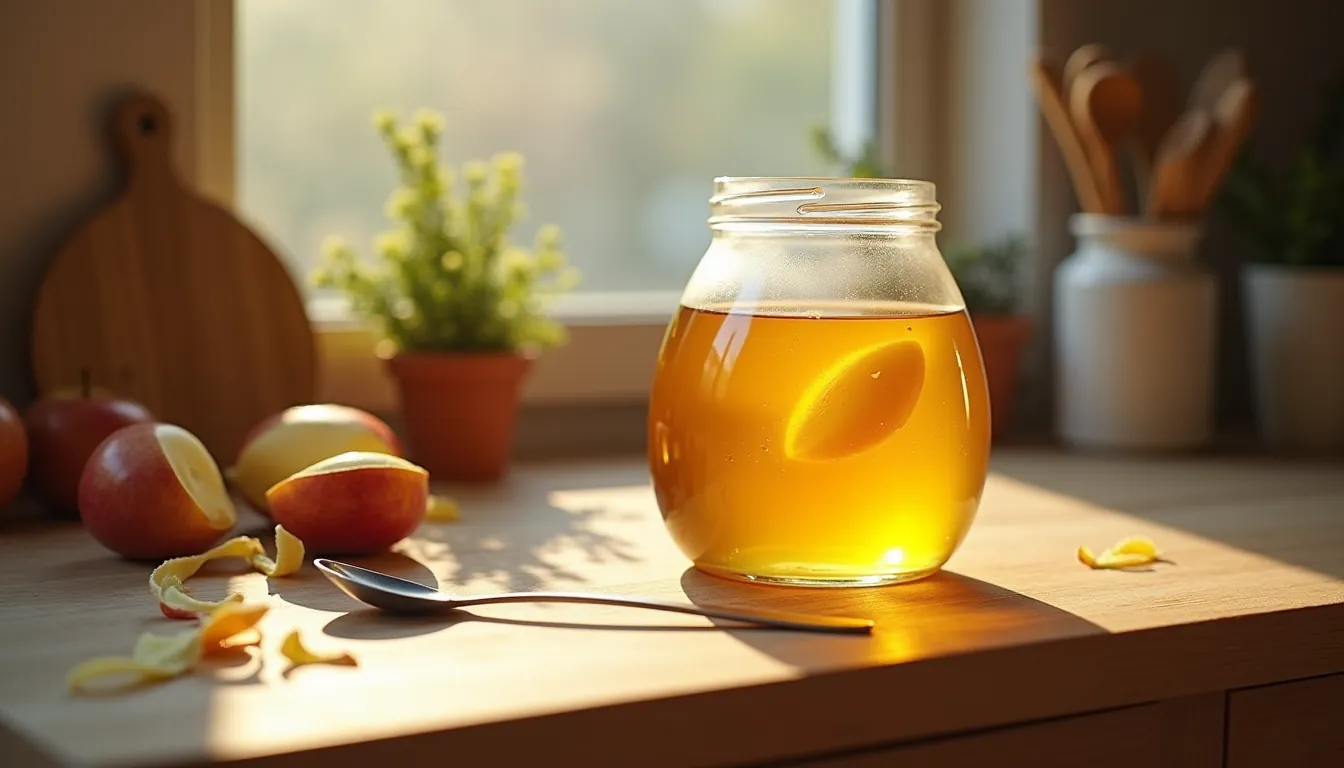
The first sign is the smell: sharp, bright, the green tang of apples lingering under the acid. Then the mother appears, a pale, jelly-like disc floating on the surface of the jar. Acetobacter at work, turning clean fruit scraps into vinegar.
Old books say vinegar was once made from whatever sound fruit came to hand. Modern sources are more careful. They confirm what the old methods guessed: fruit scraps, sugar, water and time are enough, but the process demands attention to detail.
Why make vinegar from scraps
Fruit peels, cores and trimmings hold enough sugar to feed yeast and then acetic acid bacteria, so long as they are sound and clean. The University of California’s 1917 bulletin on vinegar from waste fruits describes using cull fruit for commercial production. At home, the same principle applies to kitchen leftovers.
Here’s the catch: the scraps must be fresh. Windfall or dropped fruit may carry mould or bacteria that ruin the batch, so only clean, unspoiled material should be used.
The science: fermentation in two stages
Yeast comes first. It consumes the sugars in the fruit scraps and added sugar, converting them to alcohol. Then acetic acid bacteria take over, turning the alcohol into acetic acid. The second stage requires oxygen and a steady temperature between 60–80°F (15–27°C). Lower temperatures don’t always give usable vinegar, and higher ones interfere with forming the mother.
The two stages are distinct. If alcoholic fermentation is incomplete, residual sugar leads to weak vinegar. The 1917 bulletin warns that the alcohol must be fully formed before acetic fermentation begins, otherwise the result is poor.
What you need
The ingredients are simple: fruit scraps, water and sugar. The container must be non-reactive: glass, plastic, wood, enamel or stainless steel. Acid will corrode aluminium or other reactive metals, so these are best avoided.
A breathable cover is essential. Acetic acid bacteria require oxygen, so a cloth secured with a rubber band or string allows air to reach the liquid while keeping out dust and insects.
Step-by-step: scraps to vinegar
Start by washing the scraps and removing any signs of spoilage. Combine them with the sugar-water in the container. Cover with cloth and stir daily.
Full fermentation takes about 3–4 weeks, with tasting possible from about 4 months and up to 6 months in total, depending on temperature and conditions.
A jelly-like mother will form naturally on the surface. This is a harmless layer of acetic acid bacteria, a sign that the process is working.
Using a starter culture speeds up the process. The 1917 Cruess bulletin recommends adding new vinegar after alcoholic fermentation to introduce the right bacteria.
Mixing fruit types in one batch is fine, but the flavours will blend and the result may be less predictable.
The mother: what it is
The mother is not harmful. Ask Extension confirms it is a natural part of the fermentation process, a colony of acetic acid bacteria. It forms as the acetic acid bacteria develop during fermentation.
If mould appears, blue, green or white, discard the entire batch. Ask Extension says to discard the ferment if other-coloured moulds appear.
Acidity and limits
Commercial vinegar for pickling must be 5% acidity to ensure safety. The National Center for Home Food Preservation and Ask Extension both warn that homemade vinegar’s acidity is variable and cannot be guaranteed. For this reason, homemade vinegar should never be used for canning, where botulism is a risk.
Even if homemade vinegar tastes sharp, its acidity may not be high enough to prevent the growth of harmful bacteria in preserved foods. Stick to commercial vinegar for canning and pickling recipes that rely on precise acidity levels.
Safety
Homemade vinegar must not be used for canning or pickling where acidity matters, as its variable acidity cannot guarantee safety against botulinum bacteria. Commercial vinegars used for pickling must be 5% acidity.
If mould appears on the mother or liquid, the entire batch is contaminated and should be discarded.
Use only non-reactive containers: glass, plastic, wood, enamel or stainless steel. Acid will corrode aluminium or other reactive metals.
Avoid windfall or spoiled fruit, as these may carry spoilage bacteria or mould that can ruin fermentation. Use only clean, sound fruit.
Sterilise containers and utensils to prevent mould and bacterial contamination. Poor hygiene increases the risk of spoilage.
Keep containers out of direct sunlight at 60–80°F (15–27°C). Temperature extremes can stall or spoil the fermentation.
Storing and using your vinegar
Once fermentation is complete, the vinegar can be stored in a sealed container in a cool, dark place. Pasteurising at 170°F (77°C) held for 10 minutes can stabilise vinegar for storage, and pasteurised vinegar keeps almost indefinitely.
Use homemade vinegar for dressings, marinades or cooking. Avoid using it for canning, where safety depends on consistent acidity.
Traditional methods and adaptations
The 1917 Vinegar from Waste Fruits bulletin describes large-scale methods that still apply to the home kitchen. It emphasises the need for a steady temperature and good airflow. At home, a wide-mouthed jar achieves the same effect.
The bulletin also highlights the importance of patience. Home ferments often require months to reach full strength. The flavour deepens over time, and the acidity gradually rises as the bacteria work.
The Orleans process, described in the bulletin, involves drawing off three-quarters of the vinegar and topping up with newly fermented, settled juice.
Sources
- Ask Extension, Apple Cider Vinegar Safety
- Ask Extension, Homemade vinegar
- Ask Extension, Apple cider Vinegar
- Ask Extension, Mold on top of homemade cider vinegar
- Ask Extension, Container materials for vinegar
- National Center for Home Food Preservation, General Information on Pickling
- Ask Extension, Acids for canning
- Cruess, W. V., Vinegar from waste fruits
Comments (0)
No comments yet.
Log in to comment.