When to Plant Garlic: Why the Date Depends on Your Climate
Garlic cloves go into the soil months before they become the papery bulbs on the kitchen bench. Plant too early and winter-kill of the top growth can leave you with fewer cloves, or none. Plant too late and roots may not have enough time to grow before the ground freezes, delaying spring shoots. The calendar matters, but so do the leaves.
Choose a type and healthy planting stock
Garlic (Allium sativum) comes in two familiar forms: softneck and hardneck. The difference is plain once the plants mature. Softneck leaves remain flexible after curing, making them suitable for braiding. Hardneck garlic sends up a stiff, woody flower stalk called a scape.
That distinction shapes what you do after harvest. A softneck braid can hang as a tidy bundle, while hardneck stems don’t bend readily into the same form. Both types need to be cured and stored with care.
Start with planting stock that’s healthy and free of visible blemishes or disease. Penn State Extension recommends disease-free stock as part of limiting disease problems. Choose stock intended for planting and inspect it before it goes into the bed. Each clove can grow into a bulb.
Prepare the bed
Choose a sunny site with well-drained soil. Garlic is vulnerable to bulb diseases in poorly drained ground; Penn State Extension identifies Fusarium bulb rot and other bulb diseases as major problems where drainage is poor. Waterlogged soil makes a poor home for a crop that needs to remain in place through a long growing season.
Prepare the bed so water can drain away rather than linger around the bulbs. Rotation helps limit disease problems. Garlic belongs to the Allium group, so keep that family relationship in mind when planning the next season’s bed. The same principle becomes especially important if rust appears.
Time planting to your region
Garlic planting dates are regional. Penn State Extension recommends mid- to late October in Pennsylvania. Nebraska Extension recommends early- to mid-October in Nebraska, roughly four to six weeks before the ground freezes. These dates reflect local conditions; neither is a universal October rule.
The reason for planting in autumn is the cold exposure garlic needs to form bulbs. Nebraska Extension says cloves need temperatures between 32 and 50°F for one to two months to induce bulb formation. Use a regional recommendation rather than treating a date from another state as a prescription.
If fall planting was missed, very early spring planting is an option. Nebraska Extension places that window typically in March or April locally. It also notes that garlic planted in spring still needs the cold exposure required for bulb formation.
Tend the crop through the season
Penn State Extension and Nebraska Extension include watering and mulching in garlic crop care. Adjust watering to local conditions, and use mulch as part of managing the bed. Keep it weeded so weeds don’t compete with the crop.
Hardneck garlic produces a woody scape, the flower stalk that distinguishes it from softneck types. Penn State Extension advises removing scapes. Softneck plants don’t form that same hard stalk.
Keep an eye on the foliage as the season advances. Yellowing and browning will eventually help signal harvest time, but a sudden pattern of leaf damage deserves attention sooner. Garlic rust starts as small flecks on leaves and can progress to orange pustules. Look closely when you see spots.
Know when to harvest
Garlic is ready when the leaves begin to yellow and brown, but the exact signal isn’t a single calendar date. Penn State Extension’s production guidance recommends harvesting when 40–60% of leaves have yellowed. Its home-garden guidance says to harvest as leaves begin browning while at least four leaves remain partly green.
Those signs mark a useful balance. Harvest too early and bulbs may be smaller. Wait too long and they can split. Check the plants rather than relying on a fixed number of days after planting; the crop’s condition is the better guide.
When the time comes, lift the bulbs from the soil. Don’t pull them up by the stems. Freshly harvested garlic bruises easily, and rough handling can speed deterioration. Work gently, keeping the bulbs intact as they come out of the bed.
Cure the bulbs
Curing dries the plant and prepares the bulbs for storage. Keep garlic out of direct sun and protect it from weather while it dries. Airflow matters.
Oregon State University Extension advises drying plants out of direct sun for a week or more, until the skins are papery. Penn State Extension’s production guidance recommends curing on racks with good airflow, sheltered from sun and weather, for about three weeks or until the outer leaves are dry. The timelines differ, so watch the condition of the crop as it cures.
Choose a sheltered place where air can move around the plants. Racks provide space for airflow. Papery skins and dry outer leaves are the signs given in the extension guidance. Once cured, the bulbs are ready for suitable storage.
Braid softneck garlic
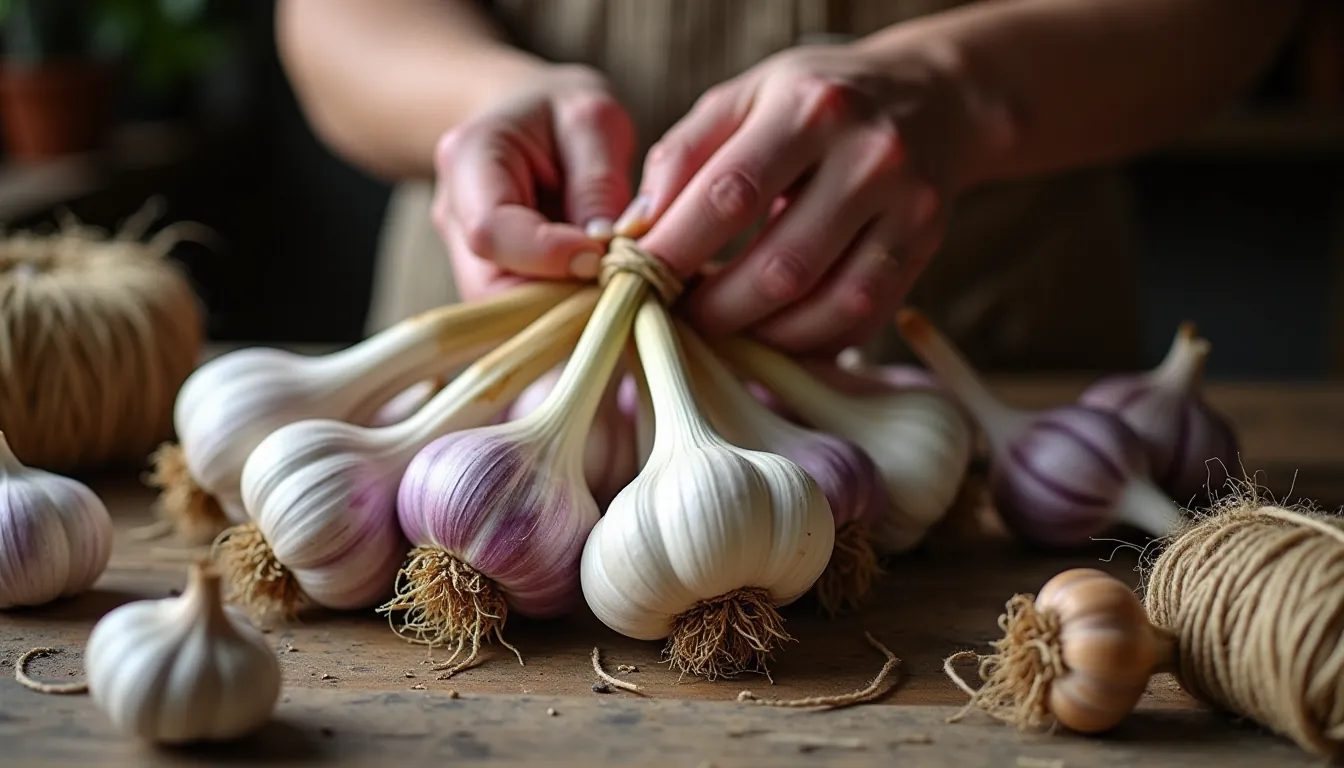
Softneck stems stay flexible after curing, which is why they can be braided. Hardneck stems become woody and don’t suit the same treatment. If you want a braid, choose softneck garlic.
Nebraska Extension’s method begins after harvest. Let the tops wilt for two to three days, then braid them tightly. After braiding, allow the bulbs to finish curing. As the stems dry, they shrink, so a firm braid helps hold the bulbs together.
Keep the braid in a place with good airflow and suitable storage conditions. Braiding arranges the bulbs; curing and storage conditions determine how well they keep. A braid can’t make up for insufficient drying.
If the stems are too stiff to bend, they may be hardneck garlic. Don’t force them into a braid. Cure those bulbs and store them in another ventilated form, such as a mesh bag or slatted crate.
Store bulbs and prevent rot
After curing, garlic needs a cool, well-ventilated place. Oregon State University Extension lists mesh bags, slatted crates and braids as storage options. It gives ideal conditions of 32–38°F and below 70% humidity.
Under suitable conditions, OSU gives potential storage lives of up to nine months for softneck garlic and six months for hardneck. These are upper limits, not promises for every home. Keep the bulbs cured, cool and ventilated.
Garlic bruises easily after harvest, and bruising speeds deterioration. Poor drainage in the growing bed can lead to Fusarium bulb rot and other bulb diseases. Disease-free planting stock, well-drained soil, careful handling, thorough curing and cool storage all help limit problems.
Recognise garlic rust and limit its spread
Rust begins as small flecks on the leaves. UC Statewide Integrated Pest Management Program describes the next stage as reddish- to dull-orange pustules, often oval or diamond-shaped. In a severe infection, leaves can yellow and die, and bulb size and quality can decline.
The fungus is active in cool conditions and spreads through airborne spores released by the pustules. Volunteer garlic and weedy Alliums can host it between crops. Keep an eye on nearby plants in the same family, not just the garlic bed.
If rust appears, UC IPM recommends removing volunteer Alliums and rotating away from Allium crops for two to three years. Spotting symptoms early helps you plan the next rotation. Small leaf flecks are easy to overlook. Look closer.
Safety
Garlic is a low-acid vegetable. Oregon State University Extension warns that Clostridium botulinum can produce a potentially fatal toxin in improperly stored garlic-in-oil. Don’t keep raw, untreated garlic in oil at room temperature. Refrigerated garlic-in-oil should be kept for no more than four days; freeze it for longer storage.
OSU describes acidifying peeled cloves by covering them with undiluted wine or vinegar, then refrigerating them. For canning, Penn State Extension states there are no safe methods for canning garlic.
Sources
- Penn State Extension, “Garlic Production,” https://extension.psu.edu/garlic-production
- Oregon State University Extension Service, “Preserving garlic,” https://extension.oregonstate.edu/food/preservation/preserving-garlic
- University of Nebraska–Lincoln Extension, “Garlic Production in the Home Garden” (G2221), https://extensionpubs.unl.edu/publication/g2221/na/html/view
- Penn State Extension, “Growing and Using Garlic,” https://extension.psu.edu/growing-and-using-garlic
- UC Statewide Integrated Pest Management Program, “Rust / Onion and Garlic,” https://ipm.ucanr.edu/agriculture/onion-and-garlic/rust/
Comments (0)
No comments yet.
Log in to comment.